Elevate Your Excellence


Vision boards and visualization have become a familiar tool in conversations about goals, performance, motivation, and personal growth. For some people, they are inspiring. For others, they seem suspiciously close to adult arts and crafts with better branding. Both reactions are understandable. A vision board can be useful, but only when we are clear about what it can and cannot do.
A vision board does not change behavior by itself. It does not make a goal more likely simply because the goal has been printed, pinned, saved, or arranged next to an aesthetically pleasing photograph of a coastline. The image may matter, but the image is not the intervention. The psychological value of a vision board comes from what it helps the brain rehearse.
That is where vision boards and visualization becomes essential.
Vision Boards vs. Visualization: What Is the Difference?
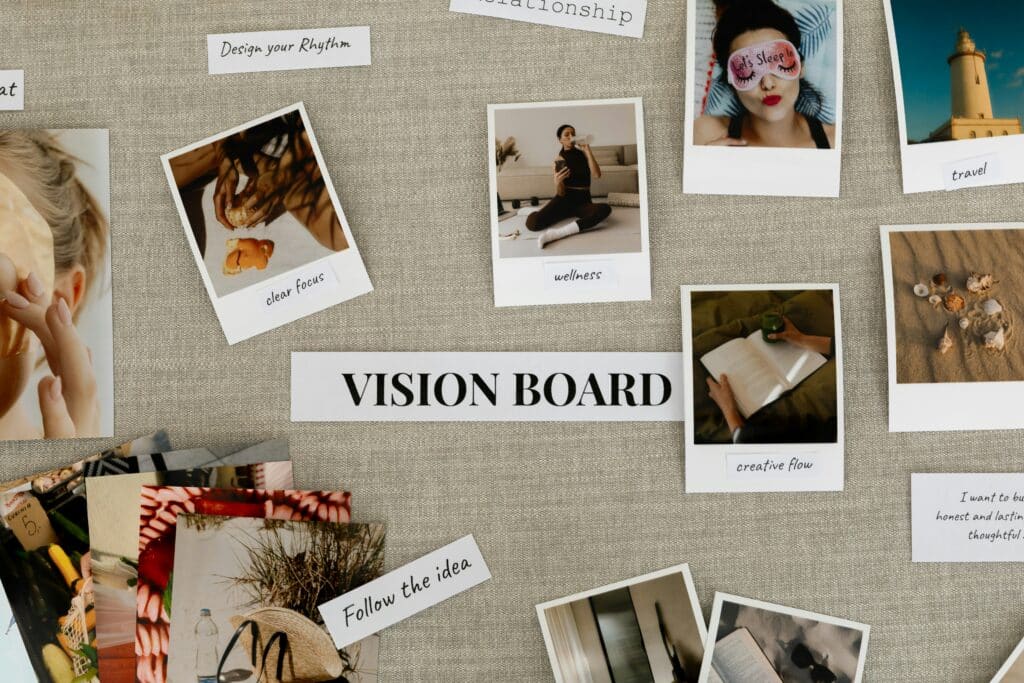
Visualization is the active cognitive behavioral process of mentally rehearsing a desired behavior, response, or outcome before it occurs. It is not simply picturing success. It is practicing the internal and external steps required to move toward success. A vision board can help identify what matters. Visualization helps train the mind to act in alignment with it.
This distinction matters for executives, elite athletes, entrepreneurs, and high-performing professionals because ambition is rarely the problem. Most high performers do not lack goals. They often have too many of them, preferably color-coded and attached to unrealistic timelines because apparently exhaustion looks more respectable when it is organized. The more common challenge is not seeing the destination. The challenge is repeatedly behaving in ways that support the destination when stress, fatigue, fear, frustration, or pressure enter the room.
Why Vision Boards Alone Don't Change Behavior
A vision board may show the business you want to build, the level of health you want to maintain, the competitive result you want to achieve, the leadership presence you want to embody, or the life you want to create. That can be meaningful. Images can clarify values. They can focus attention. They can remind a person of what they are trying to pursue when daily life becomes noisy and reactive.
But images alone do not build tolerance for discomfort. They do not automatically change avoidance patterns. They do not teach the nervous system how to stay regulated during a difficult conversation, a poor performance, a financial setback, a hard training day, or a moment of public scrutiny. A vision board may show the podium, the office, the published book, the healthy body, or the calm family dinner. Visualization asks the more important question: What will you practice doing when the path toward that image becomes difficult?
That is the psychological pivot.

How Visualization Turns Goals Into Mental Rehearsal
Cognitive behavioral strategies are based on the relationship among thoughts, emotions, physical sensations, and behaviors. A person’s internal narrative affects emotional state. Emotional state affects physiology. Physiology influences behavior. Behavior then reinforces belief. This cycle can either support progress or quietly sabotage it.
A vision board can activate desire, but visualization trains response.
An executive might place an image representing leadership, influence, or strategic growth on a vision board. That image may be useful as a reminder of identity and direction. The visualization process goes further. The executive mentally rehearses walking into a tense meeting, hearing resistance, noticing the urge to become defensive, pausing, and responding with clarity. The brain practices leadership behavior, not merely leadership branding.
An elite athlete may include images representing strength, competition, recovery, or achievement. Those images may help anchor commitment. Visualization turns that commitment into rehearsal. The athlete pictures a missed shot, a slow start, an unexpected mistake, or a moment of fatigue. Then the athlete practices the reset: breath, posture, focus, next action. The board may show the goal. Visualization trains the recovery.
An entrepreneur may create a board reflecting financial growth, visibility, impact, or freedom. The board may clarify why the work matters. Visualization prepares the entrepreneur for the investor who says no, the launch that underperforms, the client who hesitates, or the day when motivation is not available for consultation. The person rehearses staying engaged, making the next call, asking the better question, and not confusing a hard day with a failed identity.
When Vision Boards Can Become Discouraging
This is why vision boards without visualization can become emotionally risky for some people. Not dangerous in a dramatic sense, but unhelpful in a quieter way. When people repeatedly look at an ideal outcome without rehearsing the process required to reach it, the gap between current reality and desired future can start to feel discouraging. The board becomes a reminder of what has not happened yet. Instead of creating clarity, it creates shame. Instead of supporting action, it reinforces the belief that the person is behind.
That is not a failure of the person. It is a failure of the method.
How to Make a Vision Board More Effective
A more effective approach is to use the vision board as a starting point, not the strategy itself. Each image should lead to a behavioral question. What does this goal require me to practice? What discomfort will I need to tolerate? What thought pattern is likely to interfere? What action will I take when motivation drops? What will I do when the first attempt does not work?
This keeps the work grounded. A vision board may represent a healthier body, but visualization rehearses waking up tired and still choosing the workout, the walk, the meal, the appointment, or the recovery practice. A vision board may represent professional visibility, but visualization rehearses sending the pitch, speaking in the meeting, tolerating criticism, or staying present when attention feels uncomfortable. A vision board may represent a stronger relationship, but visualization rehearses listening without interrupting, asking for what is needed, and staying regulated during conflict.
The image gives the brain direction. The rehearsal gives the brain a pathway.

How Mindset Coaching Helps Turn Vision Into Action
This is also where mindset coaching becomes useful. People often interpret struggle as evidence that the goal is wrong, the timing is wrong, or they are not capable. Visualization helps separate difficulty from failure. It allows a person to anticipate obstacles without treating them as proof of inadequacy. A hard conversation is not evidence that someone is a poor leader. A missed performance target is not evidence that an athlete is weak. A stalled business goal is not evidence that an entrepreneur is incapable. Difficulty is information. It is not identity.
Vision boards work best when they are paired with disciplined mental rehearsal. The board says, “This matters.” Visualization says, “Here is how I will practice becoming the person who can move toward it.” That difference is not small. One is inspiration. The other is training.
Put Your Vision Board Into Practice
The practical takeaway is straightforward. Keep the vision board if it helps you clarify your goals, values, and direction. But do not stop there. Choose one image. Identify one behavior connected to it. Mentally rehearse the moment when that behavior will be difficult. Picture the stress, the doubt, the resistance, or the inconvenience. Then practice the response you want to choose anyway.
That is where the real work begins.
Vision boards may help you see what you want. Visualization helps you practice who you need to become and what you need to do when the process becomes uncomfortable. The future is not built by staring at the picture. It is built by rehearsing the behaviors that make the picture more likely to become real.
Apparently, even inspiration needs a follow-through plan.
Ready to Turn Your Goals Into Action?
Knowing where you want to go is only part of creating meaningful change. Coaching can help you identify the patterns that interfere with your goals, strengthen the behaviors that move you forward, and develop practical strategies for navigating the discomfort that comes with growth.
If you are an executive, entrepreneur, professional, or other high-performing adult who is ready to move beyond intention and create meaningful behavioral change, Dr. Robin Buckley offers individual coaching designed to help you turn insight into intentional action.
Ready to move from vision to action? Learn more about executive coaching with Dr. Robin Buckley or book a call now.