Elevate Your Excellence


Dr. Robin Buckley’s Key Insights
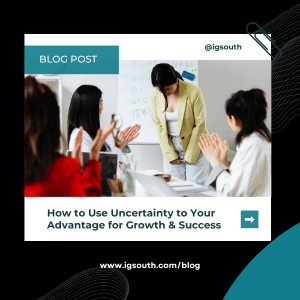 Dr. Robin Buckley, an executive coach in New Hampshire, explains that our aversion to uncertainty stems from evolutionary survival instincts. Our early ancestors equated uncertainty with danger and avoided it at all costs, like steering clear of dark caves that might harbor threats.
Buckley notes that while avoiding the unknown was once necessary for survival, staying locked in familiar habits and patterns today prevents expansion, creativity, and new growth. She emphasizes that when we have the ability to explore but don’t, we limit ourselves.
On the positive side, Buckley points out that learning to be comfortable with murky circumstances can lead us to people and things we might never have found if we stayed on autopilot.
Dr. Buckley’s Practical Advice
Review your personal history: Instead of doubting your ability to handle new situations, think back on how you’ve coped with challenging experiences in the past, such as managing life during the pandemic.
She suggests tapping into your proven strengths, such as resourcefulness and optimism, noting that recalling traits that have helped you succeed before gives your brain hard evidence that you already have the skills to cope.
Practice staying present: Buckley recommends writing down a nightly list of three things that brought you joy that day, simple things like a ladybug on the window or your dog’s morning greeting.
This practice primes you to look for joyful moments throughout the day, strengthening your ability to stay in the moment and control your thoughts, which ultimately helps control your feelings.
Read the entire article on how to use uncertainty to your advantage.
Why Uncertainty Is Your Secret Weapon for Growth
In an unpredictable world, the ability to use uncertainty to your advantage separates those who thrive from those who remain stuck in the status quo.
 Research suggests that while our ancestors viewed the unknown as a threat requiring immediate danger avoidance, modern life demands a different approach. Business leaders and executives today must develop the mindset to turn uncertainty into a signal advantage rather than viewing it as something to fear.
Dr. Robin Buckley’s insights reveal how black and white thinking keeps us trapped in familiar patterns, even when better outcomes await beyond our comfort zones.
Organizations that practice scenario analysis and engage with multiple possibilities rather than seeking an absolute certainty position themselves to respond more effectively when circumstances shift.
This growth mindset allows both individuals and companies to explore new opportunities that would remain hidden if we only focused on what happened in the past.
READ: Mindset Beats Skill: Why Your Thinking Determines True Success
The tendency to avoid uncertain times often stems from anxiety about consequences we cannot control. However, when leaders build resilience and take baby steps toward the unknown, they discover an unmet need for courage that, once fulfilled, transforms how they deal with challenges.
A serial entrepreneur or managing partner who can imagine different futures and prepare for various factors will always outperform those overwhelmed by the sheer number of variables at play.
Practical Strategies to Navigate the Unknown
Learning how to embrace uncertainty begins with understanding that doubt doesn’t have to be paralyzing. Young people entering the job market, for instance, often face situations where many things remain undecided about their career path.
Rather than letting this lead to inaction, they can develop practices that help them focus on what they can control in the present moment.
The essential guide to managing an uncertain future involves breaking down overwhelming challenges into manageable actions. When you engage with a new situation, your brain’s prefrontal cortex activates to help you make sense of the environment and identify the most valuable data points.
This neurological response demonstrates our natural capacity to thrive even when we cannot predict what will happen next.
Business executives who cultivate curiosity about uncertain outcomes tend to discover opportunities their competitors miss. By examining the market through multiple lenses rather than relying solely on past performance, they position their company to respond quickly when circumstances change.
READ: The Shocking Ways Data Bias Makes Women ‘Irrelevant,’ and What We Can Do to Stop It
This forward-thinking strategy acknowledges that while we cannot eliminate risk, we can prepare ourselves to lead through whatever challenge emerges.
The key is to practice staying grounded in the present moment while maintaining flexibility about the future, a skill that matters immensely in today’s rapidly evolving business landscape.
Building Your Uncertainty Advantage: From Theory to Action
To truly embrace uncertainty as a competitive edge, organizations must move beyond theoretical understanding to practical implementation. The uncertainty advantage comes not from having all the answers, but from developing systems that allow teams to explore possibilities without becoming paralyzed by the unknown.
 This requires leaders who can create an environment where calculated risks are encouraged, and people feel safe engaging with ambiguity.
Consider the example of how successful leaders respond to market shifts: rather than viewing unpredictability as a threat to be eliminated, they see it as an opportunity to develop adaptive strategies that create lasting value.
These practices involve regularly examining what’s working, what isn’t, and what factors might influence future results. By building this habit of continuous assessment, teams become better equipped to navigate whatever comes next without losing focus on their core mission.
READ: Is Niceness the New Red Flag for a Toxic Culture?
The ability to manage uncertainty effectively is not an innate trait but a skill that can be cultivated through deliberate thinking and action.
Whether you’re a managing partner making strategic decisions or an individual navigating personal life transitions, the principles remain the same: acknowledge that absolute certainty is impossible, prepare for multiple scenarios, and trust that you have the capacity to handle whatever emerges.
When we shift our relationship with the unknown from one of avoidance to one of curiosity, we unlock possibilities that transform not just our businesses but our entire approach to living in an uncertain world.